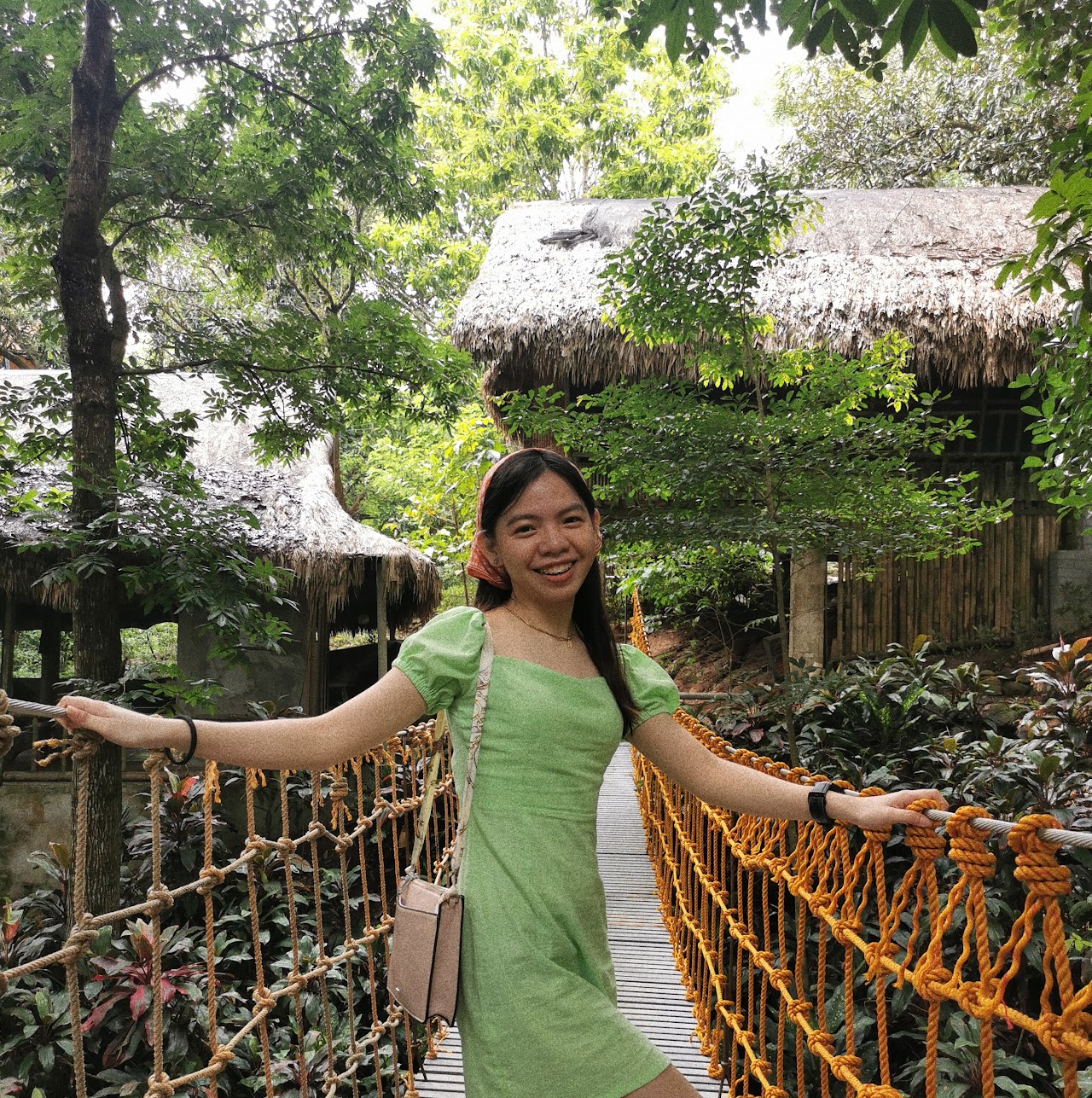
About the author
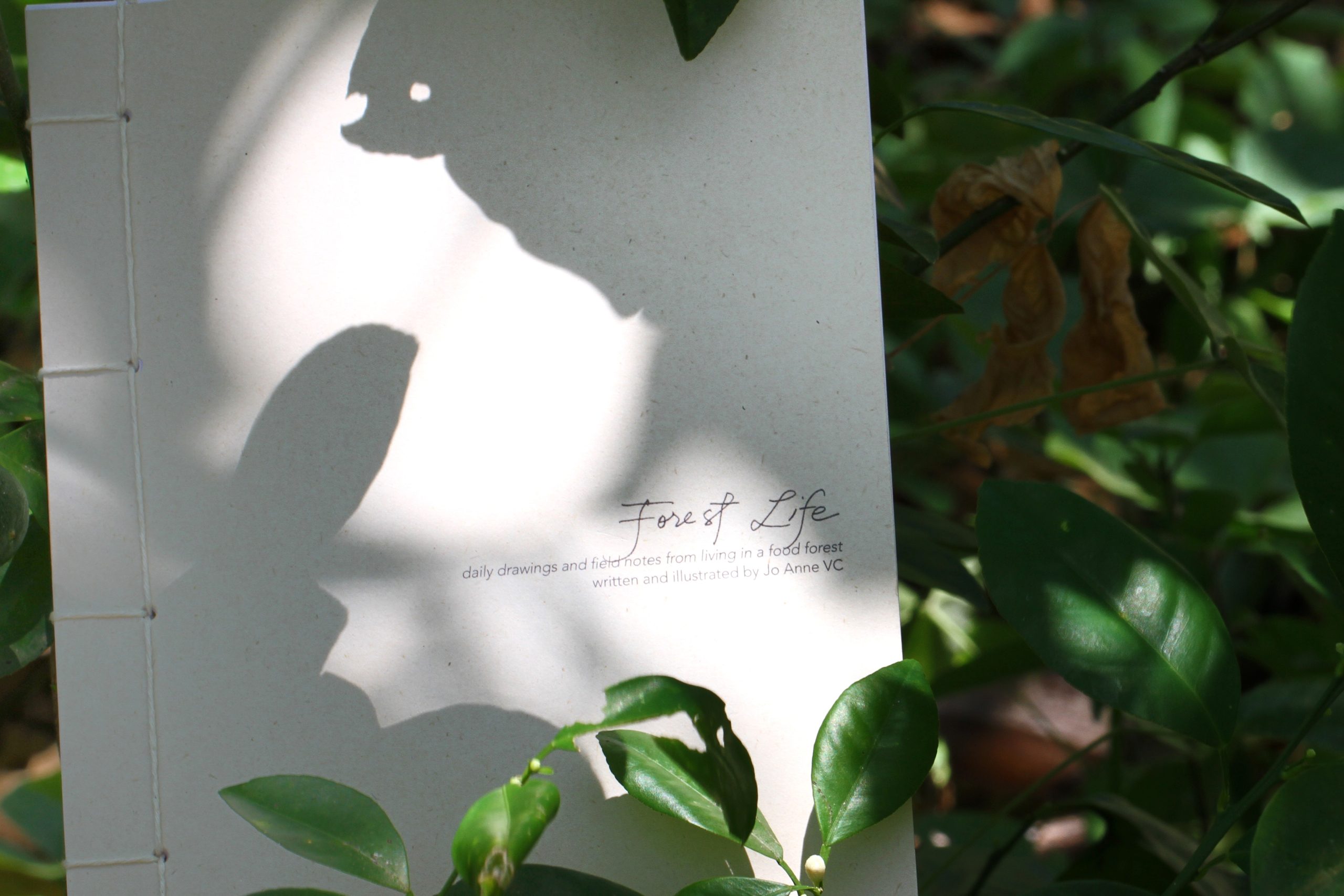
Jo Anne Coruña is an artist and naturalist based in Bacolod. Every day, she draws a co-inhabitant (frequently a plant, sometimes an animal or other living beings) of Food Forest Maria — the almost-seven-year-old permaculture forest she tends at home. Those drawings and the field notes that accompany them become Forest Life, a monthly journal-zine she prints and handbinds right in the middle of the food forest, and she shares it with readers who are slowly, gently, being invited back to nature. We asked her about the practice behind the pages.
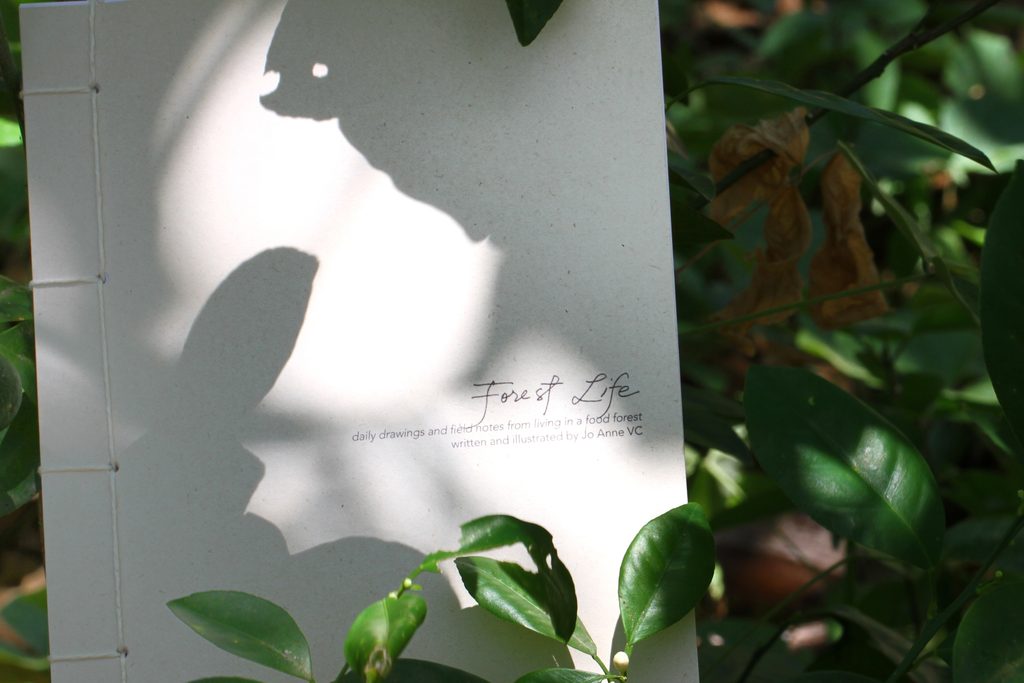
Somewhere in Bacolod, Jo Anne Coruña walks through a forest she has been growing (with) for seven years. She moves unhurriedly, the way someone does when they are observing. A Little Ironweed at the edge of the path catches her attention, its flowers so small and purple they are easy to miss. She stops. She draws it. This is how her zine, Forest Life, unfolds.
Jo Anne did not grow up outdoors. She grew up in Manila, she says, not particularly drawn to the natural world. What changed her was a sequence of arrivals: to Bacolod, then to Japan, then to a plot of land that was mostly wild grass, and finally to permaculture, a design philosophy she studied formally in 2020 and has been practicing with her hands and her pen and paper ever since. Food Forest Maria — named, as you might guess, with the reverence you reserve for someone you live with — now holds over a hundred of plant species: Ulam Raja and Katuk near the entrance, Sissoo Spinach on the Slopes, Mulberry and Talisay at the boundaries, and always, always, the wild plants pressing in.
The zine came later, but it grew from the same roots as the Forest itself: the journal practice she has kept since childhood. Drawing, she explains, is a method. To draw something is to stay with it long enough to actually see it – its structure, its relationships, its insistence on being alive. To draw is to experience and to remember.
Forest Life is published monthly. Each page pairs a daily drawing with a field note: a sketch of six groundcover plants on a drizzly morning, a reflection on wildflowers no one names, a welcome to the new year written in the voice of someone who means it. Jo Anne writes with the precision of a naturalist and the dedication of someone who has genuinely been changed by what she studies. Reading it feels less like consuming content and more like being invited on a slow and attentive walk in a place you visited for the first time.
We spoke with Jo Anne about how the zine came to be, what the forest has taught her, and why she believes drawing is one of the most intimate ways to know something.
The zine grew out of journals you had already been keeping. What shifted when you decided to go public with Forest Life?
The idea for making a zine must have started some time late last year. A specific moment or experience escapes me because from the very beginning, I’ve always kept a Forest journal and I’ve always drawn plants, animals, or fungi from our food forest — or the Forest, as I refer to her in the zine and in everyday life. I’ve kept journals since I was a child, so it felt second-nature to keep a log of everything I was doing, experiencing, and learning from growing and being with the Forest from the very start.
Drawing, on the other hand, is a way for me to learn more deeply by being more present and slowly investigating the morphology — the form and structure — of the plants and other beings in the Forest. I did not formally study natural science in school, and so the approach I have pursued in studying nature more deeply is through my art, specifically drawing with line and with watercolor, which, as my late printmaking mentor described it, is really drawing with color . Science starts by closely observing, and drawing can be a very intimate and close observation of one’s subject. Of course, I supplement this with my own readings of textbooks, research papers, and other texts about permaculture, ecology, and botany.
A zine seems to be the most accessible way to share my writings and my drawings, and so I decided to make a daily drawing to go with my daily food forest field notes, and self-publish a zine every month. I hope to nudge people to reconnect with nature, in however small a way, everyday. We humans are part of nature, so it is also a call to reconnect with ourselves.
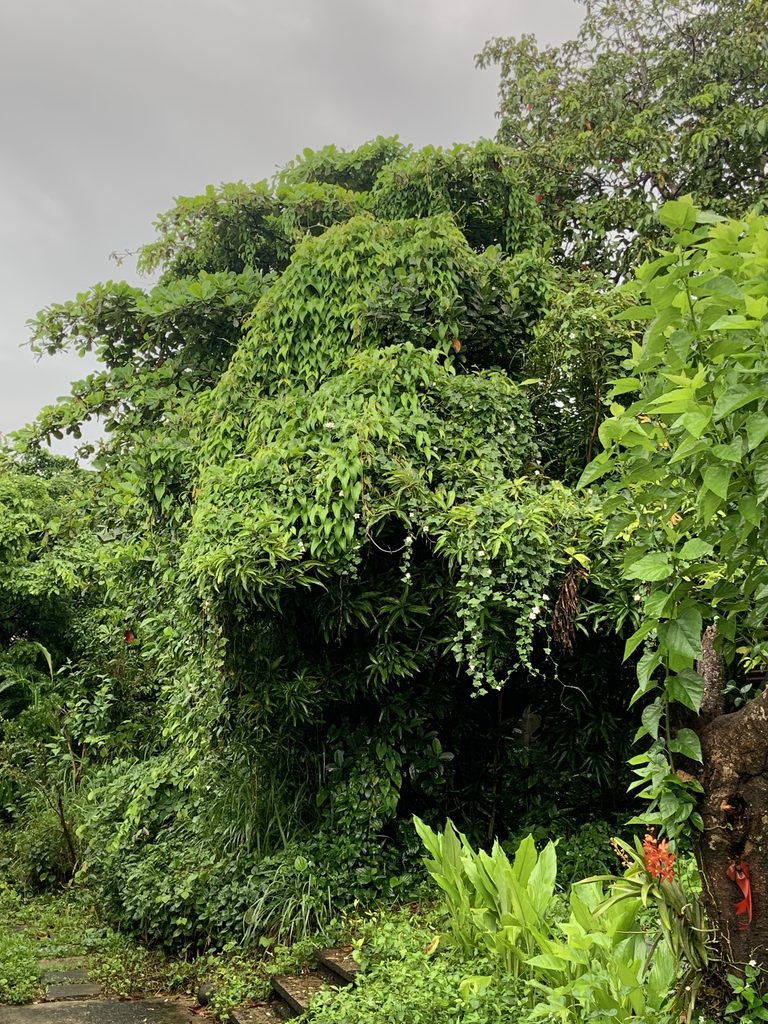
Tell us about Food Forest Maria. How did she come to be?
We planted the first seedlings in Food Forest Maria in 2019, when my family and I just came back from living in Japan for a few months. I did not grow up close to nature, so I would say Food Forest Maria really began when we moved to Bacolod over a decade ago, and I felt like I was properly introduced to nature for the first time by way of my efforts to raise my then two-year-old daughter closer to the natural world. I would often bring her to the Negros Forest Park, a biodiversity conservation center at the heart of Bacolod. And then living in Japan, nature truly felt like a quiet and reliable companion in our everyday life. Away from everything familiar — even linguistically — the trees surrounding us made us feel at home. I remember standing in the middle of the Kashihara Forest and thinking that I would love to live right next to a forest someday. I also often saw elderly Japanese tending to their vegetable gardens on our morning walks.
Before the Forest, there was mostly wild grass in the land where the food forest is now. There were also a few pioneer trees like Binunga, Alim, and a few Wild Banana plants. Wanting to have an even deeper relationship with nature, I looked around for ideas on how to approach the land, and that’s when I found permaculture. I completed my Permaculture Design Certificate course online in 2020, with the Permaculture Education Institute, which is run by Morag Gamble. The Forest started taking shape as I was still taking the course, since I was learning and simultaneously applying my learnings to the land.
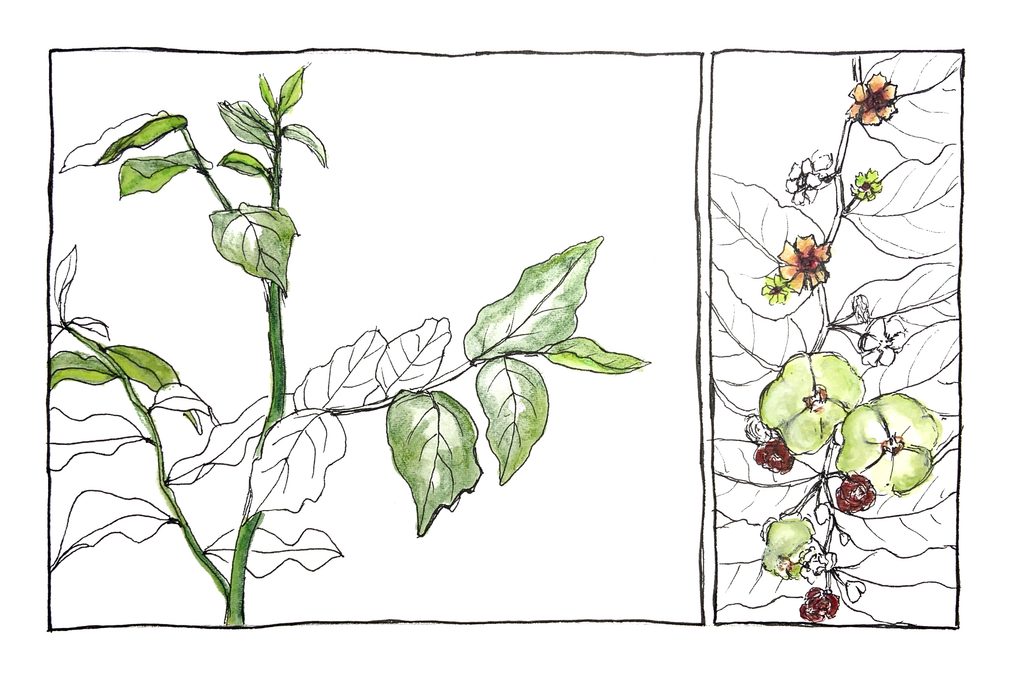
Has your relationship with the Forest changed since you started documenting it through the zine?
Even if I’ve been journaling about my work at the Forest from the very beginning, starting the zine really made me explore the Forest with fresh eyes, which I didn’t think was possible or was what I needed. Now that the Forest is turning seven years old this year, most plants are established, there’s not a lot of available spaces to plant new trees, and most of the work that I have to do is pruning. My interaction with the Forest has become mostly foraging and harvesting, and maybe taking out the occasional wild vine from covering another plant completely.
Drawing daily for the zine has made me look even more closely at each plant, animal, and fungus I come across, with more questions and definitely more curiosity, which then lead to more awe and wonder. It’s interesting to reflect on how not only the Forest and myself are growing, but also on how we relate to one another is evolving and deepening over time. Of course, there is also the matter of our climate being in crisis, and paying closer attention through drawing has really highlighted some impacts of our rapidly changing climate as experienced by the inhabitants of the Forest.
What do you hope readers find in these pages?
I really hope that readers get a glimpse of how satisfying it can be to live as part of nature. I grew up in Manila and I was not keen on being outdoors at all as a child, and I can wholeheartedly say that living close to nature — living in the Forest — has given me so much. From growing as a person myself, rediscovering the joy of just being in nature and finding an unexpected insect or bird and just observing them, to realizing that life is not about chasing worldly success but actually realizing and feeling to your bone that Life itself is the goal, that a simple life can be a full life. The Forest has taken me in and has made me feel, every day, that I am not alone and that I belong.
And it doesn’t need to be a Forest you can walk through. You can grow plants in pots, take regular walks in nearby verdant spaces, or maybe start a community garden. Being close to nature helps us remember that we are nature, too.
Life, as we have made it to be in these modern times, can be hard, and on top of our daily struggles, there are also the struggles of other people around the world; it’s pretty easy to feel helpless, maybe even hopeless sometimes. And I can understand how hard it is to live in a way that is always good for the environment — this is a constant challenge for me as well — but we can all start somewhere and we don’t have to do it alone.
We belong in nature, and we can take even tiny steps back to our place in the natural world. Even watching birds, examining a leaf, or enjoying the rain, if done with openness and an awareness and respect for Life, is a stepping stone that leads us home. And with this sense of belonging, we become empowered to stay true to ourselves and give of ourselves. I hope the zine reminds readers that plants and animals and fungi are all rooting for us, and what a gift to be able to reciprocate that, too.
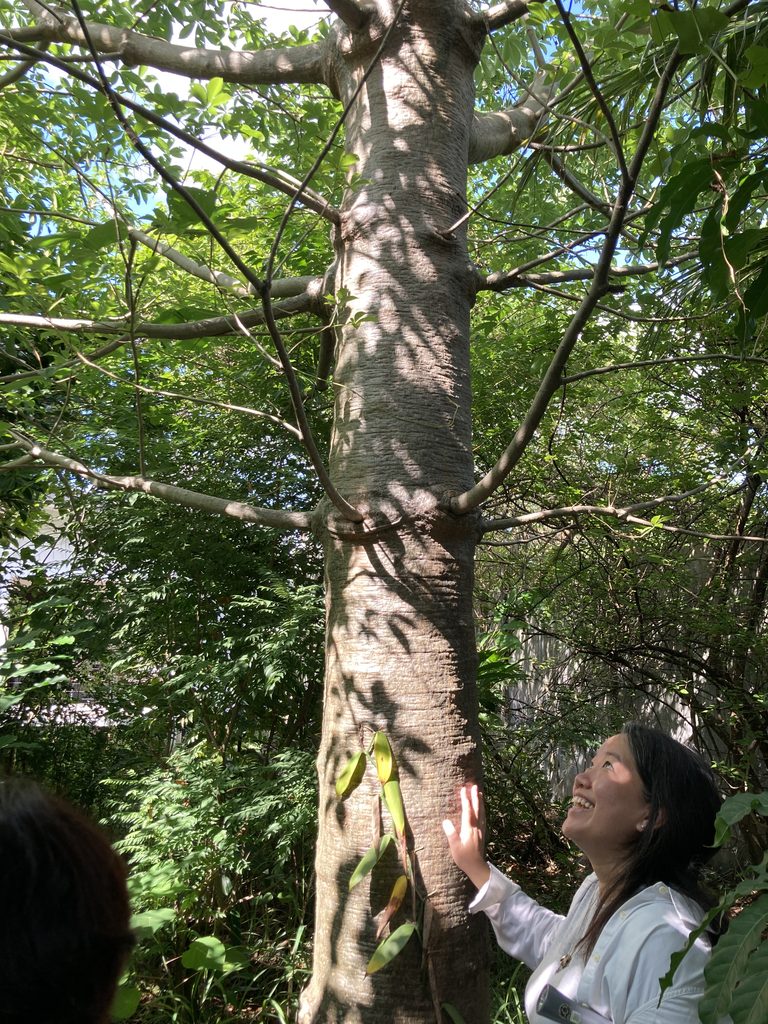
The Forest has clearly been a teacher. What has it taught you that surprised you most?
The Forest has taught me many things I did not expect, so I will share just a few.
Play. The Forest really taught me how it feels to play. I was a very serious kid who didn’t like playing outside so much or taking part in any other physical activity, so when I started spending time with the land and all the plants, animals, and fungi of the Forest, I truly believe it was my first real experience of play. Of being so immersed in something that makes me deeply and excitedly happy without any ambition to achieve something specific, without the constant fear of making a mistake. It’s in the Forest that I feel the most free. No expectations, no care for commendation or the idea of achievement. Just me as a living being, amongst other living beings, co-breathing, co-existing, co-growing.
Trust. During the first year of the Forest, we didn’t live in the area yet, so I had to take a ten-minute drive at around five in the morning every day, and I would stay and work on the land until about eight, since I had to drive back and homeschool my kids. Two to three hours every day was really what I had to work with in the beginning, and there would be many instances when there were still things I wanted to do at the Forest, but I had to leave it for the next day since there was no more time. The next day when I got back to the Forest, whatever I wanted to “fix” the previous day had already been taken care of by nature. This embedded in me a wholehearted trust in the Forest and the natural cycles and processes of life.
Belonging. I think most people who don’t spend time with nature or who don’t grow or take care of plants look at nature as something separate from them. Nature tends to be in the background, if at all considered. Plant blindness is real; I was afflicted with that, too, before Bacolod, Japan, and the Forest. And so, one thing I learned from being with the Forest is that nature truly is our kin, our family. We are a part of nature, and being separate from the rest of the natural world has carved out this vast emptiness inside us that I think people try to fill with worldly things like money or material things or the endless need to be “productive.” The Forest has taught me that we are all enough, we are capable of giving from our very selves, and that we belong.
Forest Life is a monthly journal-zine by Jo Anne Coruña, documenting life in Food Forest Maria in Bacolod, Philippines. Each issue features daily drawings and field notes from the Forest. You can find her work, enroll at her online Permaculture Design Certificate course, and support her drawing practice at www.amidstthegreen.org .
Pilipinas Journal features Filipino voices whose work and ways of knowing help us reimagine how we learn, create, and care for one another and the world we share. Contact us at hi.phjournal[at]gmail.com to collaborate.